
What Is the Standard Propane Tank Size for a Home?
Key Takeaways
- Residential propane tanks commonly range from smaller 120-gallon tanks to 1,000-gallon systems.
- A 500-gallon tank is commonly associated with a standard four-bedroom home using multiple propane appliances.
- Home size, total appliance load, climate, and propane usage all influence tank sizing.
- Propane tanks are normally filled below their total water capacity to leave room for expansion.
- A propane professional should evaluate the property before determining the appropriate tank and installation location.
Choosing a propane tank isn't simply a matter of picking the largest option available. The right capacity depends on your home's size, climate, appliances, and how heavily you rely on propane throughout the year. While homeowners often ask about the standard propane tank size, residential tanks actually come in several common capacities for different needs. T.H. Malloy helps homeowners throughout Rhode Island and Southern Massachusetts manage their propane needs with tank installation, replacement, delivery, and related home energy solutions.
What Is the Standard Propane Tank Size for a Home?
There isn't one universal tank size for every household. However, several capacities are commonly used for residential propane systems.
A general comparison looks like this:
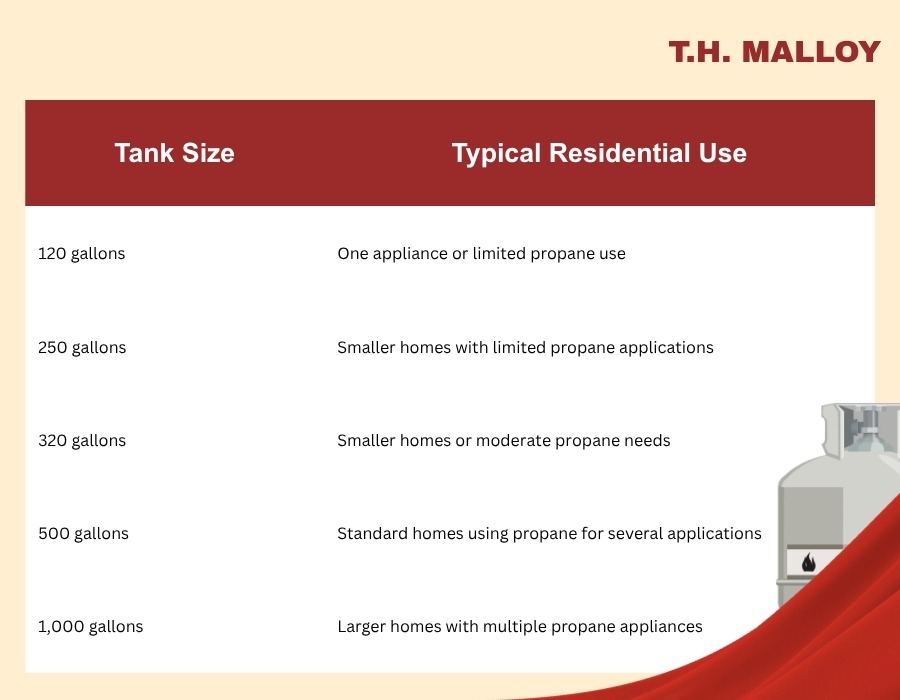
A 500-gallon tank is a common reference point for a standard four-bedroom home, while larger properties or households with greater propane demand may require 1,000 gallons. Actual requirements vary based on the property and equipment.
How to Determine the Right Propane Tank Size
Rather than choosing based on household size alone, consider how propane will actually be used.
1. Count Your Propane Appliances
Start by identifying everything that will draw fuel from the tank. Propane may power:
- Furnaces or boilers
- Water heaters
- Cooking appliances
- Fireplaces
- Clothes dryers
- Generators
A home using propane only for cooking requires significantly less storage than one relying on it for whole-home heating, hot water, and several appliances.
2. Consider Your Home's Size
Larger homes generally require more energy for heating. Square footage, insulation, ceiling height, and overall heating demand can therefore affect the appropriate tank capacity.
3. Account for Winter Demand
Climate matters when determining the standard propane tank size for a particular property. Cold winters increase heating demand, while outside temperature can also affect propane vaporization within the tank.
Tank-sizing guidance recommends considering the lowest winter temperature in the area along with the total BTU demand of connected appliances. Understanding how temperature affects propane tank performance can provide useful context when planning a residential system.
4. Think About Delivery Frequency
Tank capacity also affects how frequently propane needs to be delivered. A properly sized tank should provide enough storage for household demand while allowing practical delivery scheduling.
T.H. Malloy provides propane delivery with automatic refills, helping homeowners maintain a dependable supply without waiting until the tank is nearly empty.
Why Isn't a Propane Tank Filled to 100%?
Tank capacity can be confusing because a tank labeled for a certain capacity isn't normally filled completely with liquid propane.
Propane expands as temperatures change. For this reason, residential ASME tanks are generally filled to approximately 80% of their rated water capacity, leaving additional space for expansion.
For example, the gauge on a properly filled residential tank may read around 80 rather than 100. T.H. Malloy also explains that propane gauges indicate the approximate percentage remaining rather than the number of gallons inside the tank.
Aboveground vs. Underground Propane Tanks
Tank capacity isn't the only decision homeowners need to make. Larger residential tanks may be installed aboveground or underground when the tank and site are suitable.
Aboveground tanks are accessible for inspections and service, while underground tanks can provide a less visible option for homeowners concerned about appearance.
Property layout, required clearances, soil conditions, local regulations, and accessibility for delivery all influence where a tank can be installed. Propane system installation should always be handled by trained professionals and comply with applicable codes.
T.H. Malloy offers propane tank installation and delivery, making this a relevant consideration for homeowners establishing a new propane system or updating an existing tank.
When Should You Consider a Larger Tank?
Bigger isn't automatically better, but additional capacity may make sense when propane plays a larger role in your household.
Consider discussing a larger tank if you:
- Use propane as your primary heating fuel
- Have several propane appliances
- Operate a propane standby generator
- Have a larger home with substantial heating demand
- Plan to add more propane equipment
If you're expanding how propane is used throughout your home, you may explore Equipment Upgrades including high-efficiency propane furnaces and boilers that can become part of the overall fuel-demand calculation.
Contact T.H. Malloy & Sons, Inc. for Propane Delivery in Rhode Island and Southern Massachusetts
Choosing the right tank means balancing household demand, available space, equipment requirements, and future propane use rather than relying on a single standard size. If you're installing a new tank, replacing existing equipment, or unsure which capacity fits your property, contact T.H. Malloy & Sons, Inc. to discuss your propane needs. Their experienced team can help evaluate your household requirements and provide dependable propane support for customers throughout Rhode Island and Southern Massachusetts.
FAQs About Standard Propane Tank Size and Residential Use
Is 500 gallons the standard propane tank size for a house?
A 500-gallon tank is commonly associated with a standard four-bedroom home, but it isn't appropriate for every property. Actual sizing depends on total propane demand, home size, climate, and connected appliances.
Is a 250-gallon propane tank enough for a house?
It can be suitable for a smaller home or a household with limited propane applications. Homes relying heavily on propane may require more capacity.
Why is my propane tank only filled to 80%?
The remaining space allows liquid propane to expand safely as temperatures change. An 80% gauge reading after delivery can therefore indicate a normally filled tank.
Should I choose a 500- or 1,000-gallon propane tank?
A 500-gallon tank may suit a typical home with several propane applications, while a 1,000-gallon tank may be considered for larger homes with greater fuel demand. A propane professional should determine the appropriate size for the property.
Can T.H. Malloy & Sons, Inc. install or replace propane tanks?
Yes. T.H. Malloy & Sons, Inc. specifically lists propane tank installation and replacement among its residential propane solutions.
Stay Informed with Our Newsletter
Sign up to receive our latest updates

Insights for Your Home Comfort
Stay informed and ahead of the weather with our expert insights. Visit our blog for the latest updates and tips to maximize your home comfort.